Changes cross boundaries.
Reference changes span a median of 1,465 lines and 15 files.
 Zhejiang

Enterprise software development
PACE-Bench makes complete delivery measurable: from the final user request, to code evidence, to a diagnosis of what remains unmet.
PACE = PRD-Anchored Coding-agent Evaluation · PRD = Product Requirement Document
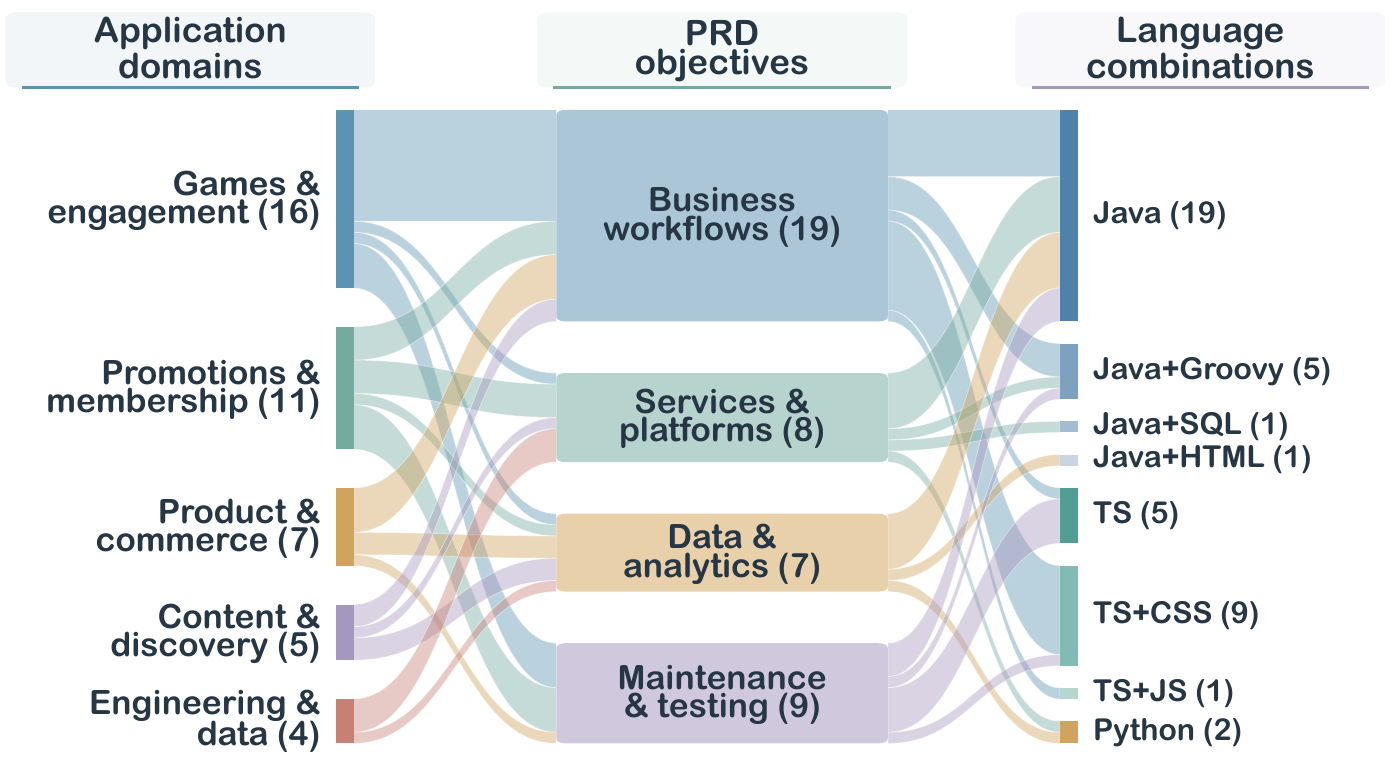
Incremental tasks in existing repositories, with expert-audited acceptance points.
Structural checks, localized code evidence, and constrained semantic judgment.
Unmet requirements linked to execution signals and implementation quality.
01 / Benchmark
Each task asks an agent to extend an established system and fulfill a final Product Requirement Document (PRD).
Reference changes span a median of 1,465 lines and 15 files.
Documents and user clarifications define the final scope.
Every required behavior needs concrete implementation evidence.
02 / Method
A Code Point is an atomic acceptance requirement, frozen before candidate evaluation.
The complete PACE-Bench pipeline
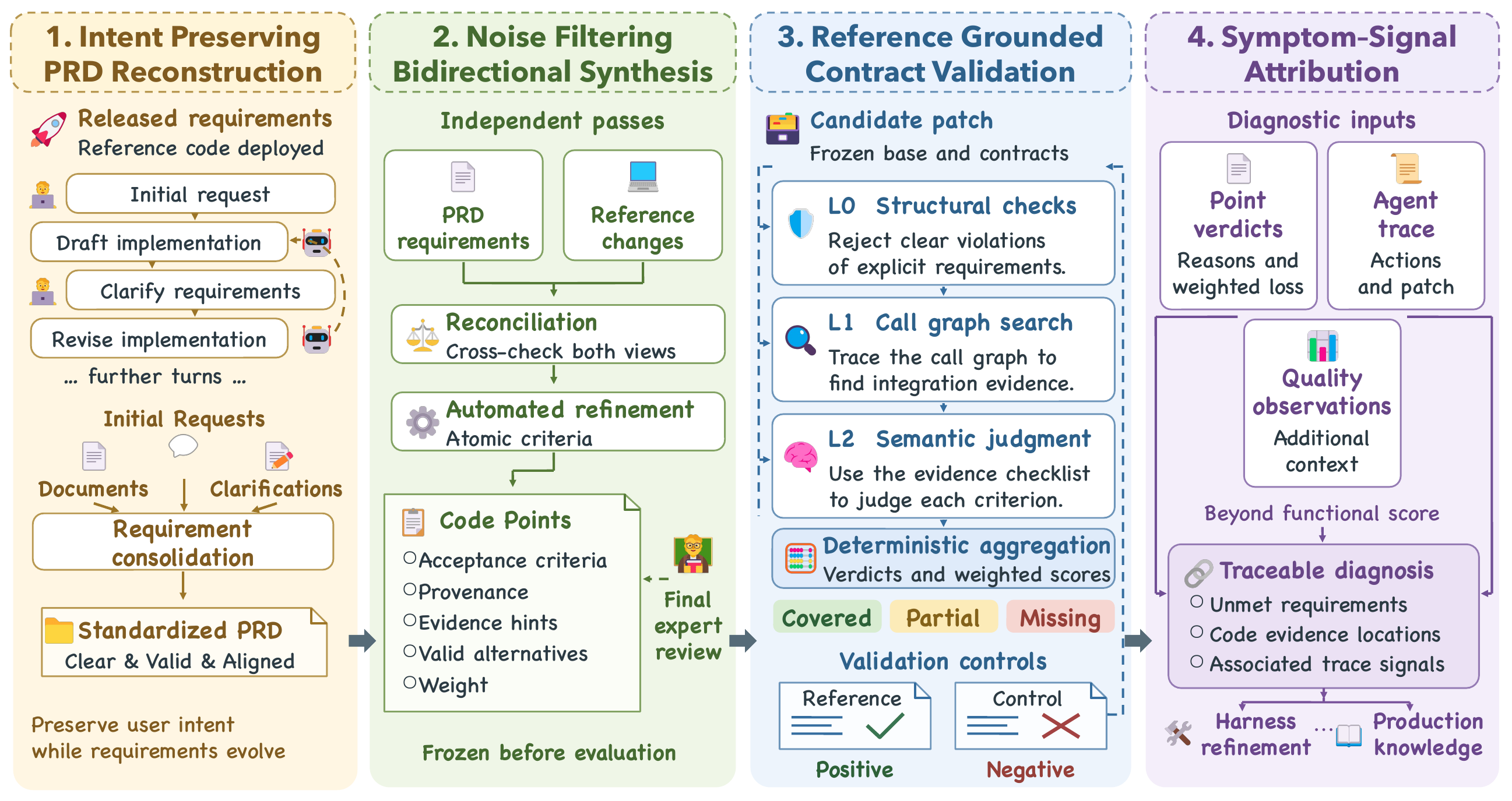
Built from Alibaba Taobao & Tmall Group’s coding-agent platform, with separate expert reviews of requirements and verdicts.
All conditions fulfilled
Real but incomplete fulfillment
A required condition is unmet
Case score = weighted fulfillment ÷ total weight × 100. System scores average cases equally. Complete delivery requires a score of at least 95 and zero Missing Code Points.
Unresolved evidence blocks a final score. Trace signals and quality observations help explain the result.
A complete inspected scope can establish that an explicit acceptance constraint is violated. Otherwise evaluation continues. Name presence alone never earns behavioral credit.
Input: frozen contract + reconstructed patch → Output: Missing or defer03 / Benchmark results
11 configurations, evaluated on the same 43 tasks. Score measures fulfillment; success counts complete deliveries.
GPT-5.6-Sol, unified minimal scaffold
GPT-5.6-Sol out of 100
Expert consensus; 17.2 percentage points above the strongest comparison judge
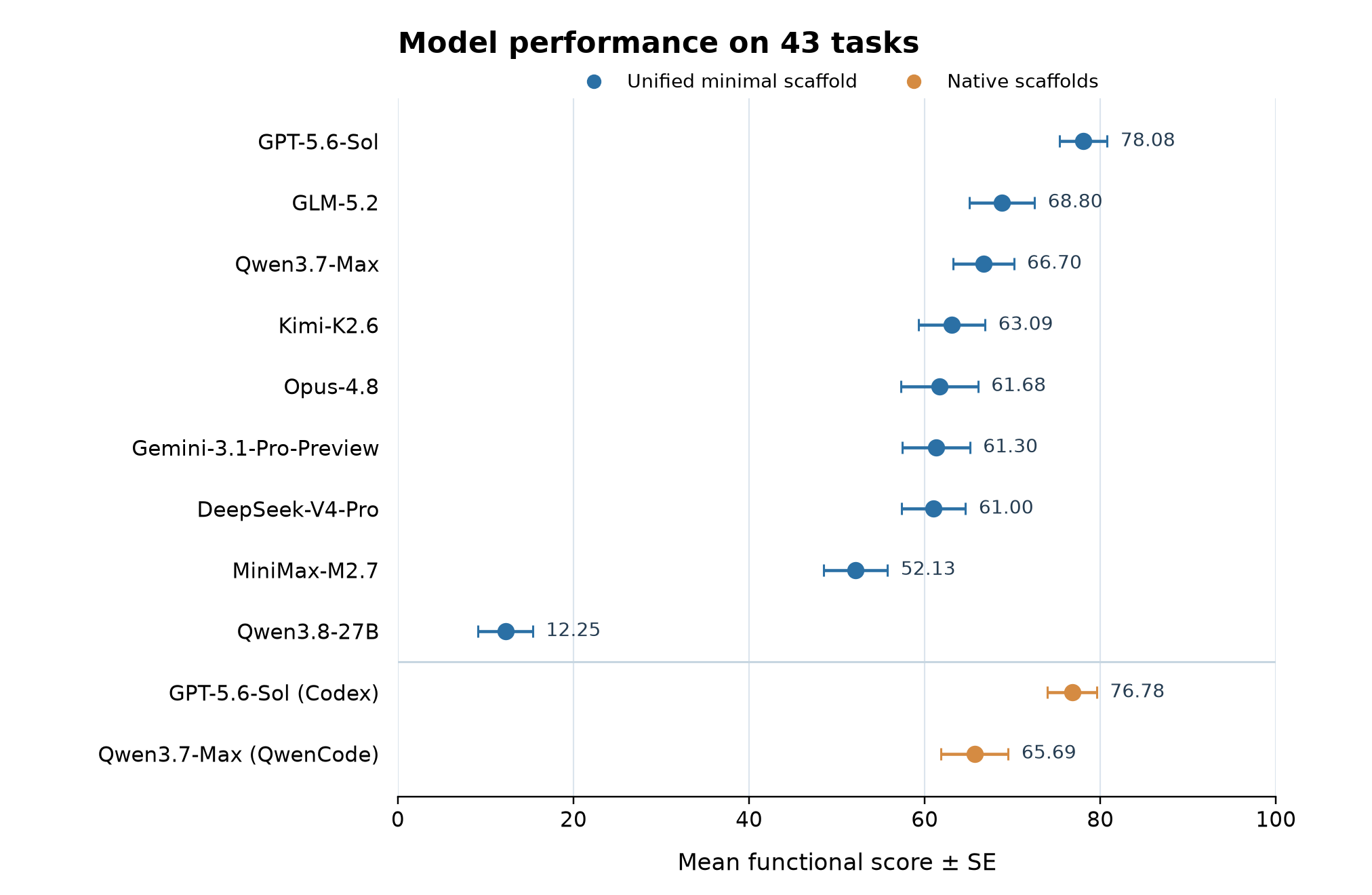
| Model | Score (mean ± SE) | Success rate |
|---|---|---|
| Unified minimal scaffold | ||
| GPT-5.6-Sol | 78.08 ± 2.71 | 14.0% |
| GLM-5.2 | 68.80 ± 3.72 | 9.3% |
| Qwen3.7-Max | 66.70 ± 3.45 | 7.0% |
| Kimi-K2.6 | 63.09 ± 3.79 | 4.7% |
| Opus-4.8 | 61.68 ± 4.39 | 7.0% |
| Gemini-3.1-Pro-Preview | 61.30 ± 3.84 | 2.3% |
| DeepSeek-V4-Pro | 61.00 ± 3.65 | 9.3% |
| MiniMax-M2.7 | 52.13 ± 3.64 | 2.3% |
| Qwen3.8-27B | 12.25 ± 3.12 | 0.0% |
| Native scaffolds | ||
| GPT-5.6-Sol (Codex) | 76.78 ± 2.81 | 14.0% |
| Qwen3.7-Max (QwenCode) | 65.69 ± 3.83 | 11.6% |
Scaffold groups follow the paper’s main table.
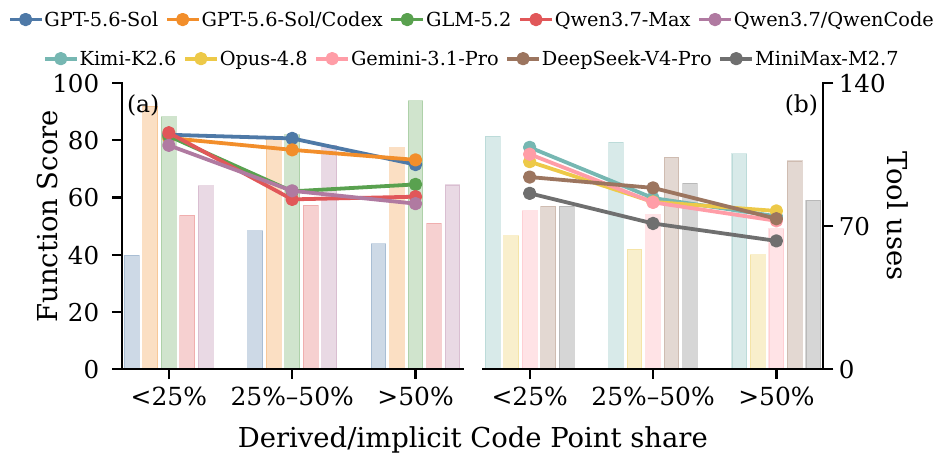
When a larger share of acceptance points must be inferred from the PRD, grouped mean scores across eight primary models are 75.0, 61.6, and 56.8 for the three bands.
04 / Evidence
Attribution, code quality, and execution observability.
What failed, and which trace signals accompany it?
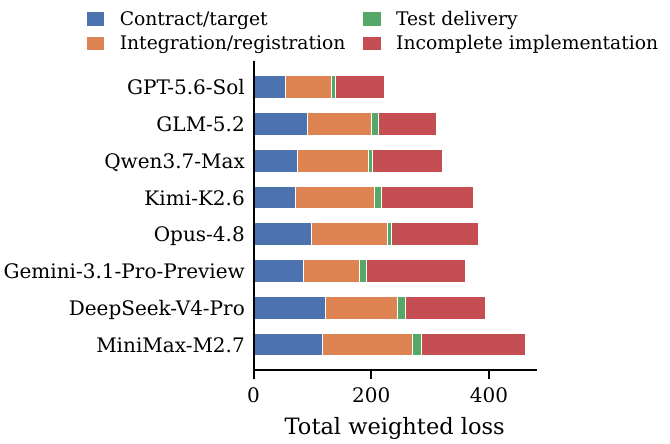
of pooled weighted loss comes from incomplete implementation and integration or registration gaps.
An incomplete handler needs behavior; an unregistered handler needs a connection. Cited Code Point evidence distinguishes them.
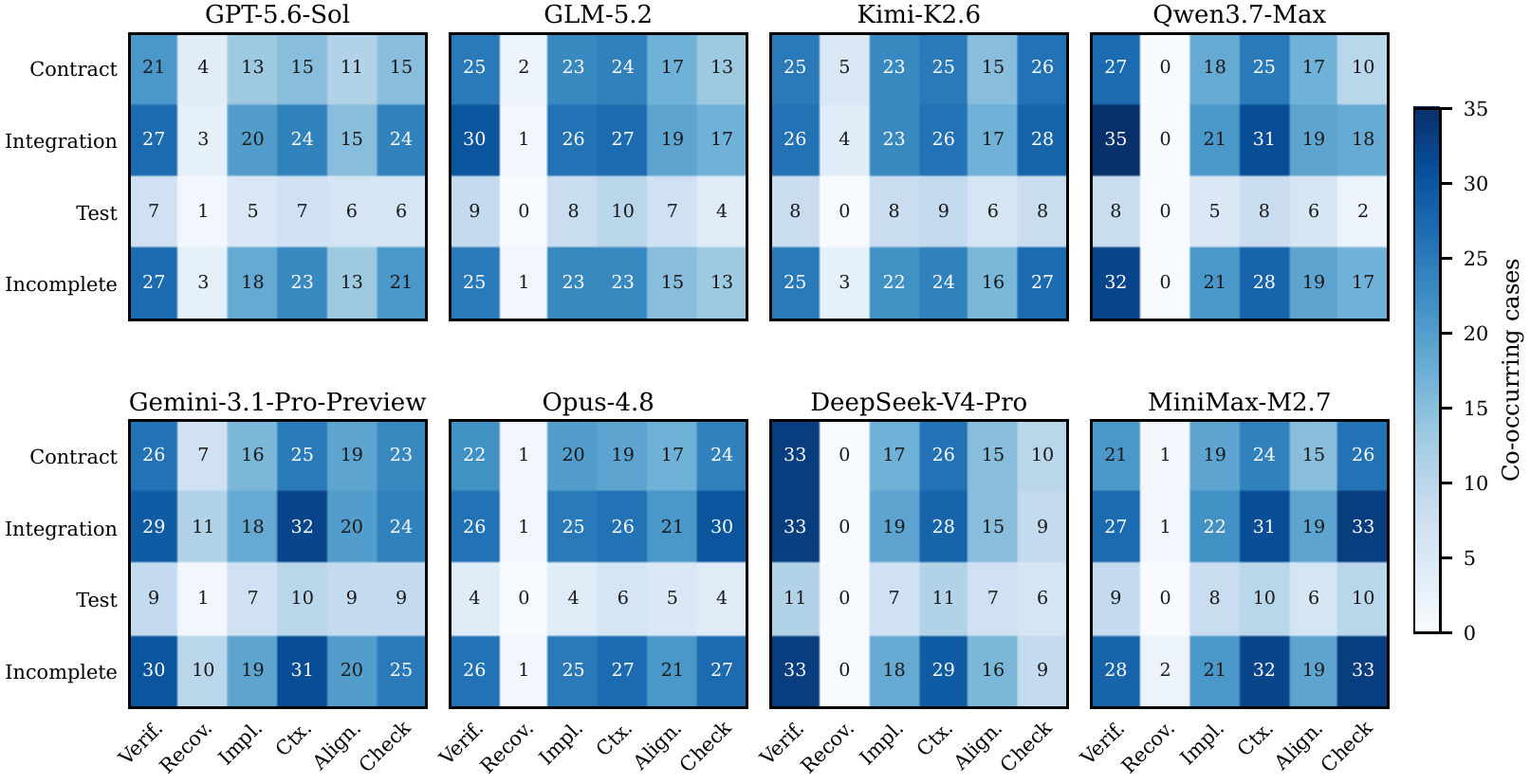
Columns: verification gap · error-recovery failure · incomplete implementation evidence · context-retrieval failure · contract-alignment failure · final self-check gap.
How does the implementation measure up?
Conventions, architecture, naming, and test delivery complement functional fulfillment.
| Model | Convention | Architecture | Naming contract | Test delivery |
|---|---|---|---|---|
| Unified minimal scaffold | ||||
| GPT-5.6-Sol | 58.2 | 68.4 | 94.3 | 47.2 |
| GLM-5.2 | 57.7 | 66.9 | 93.2 | 51.1 |
| Qwen3.7-Max | 52.5 | 62.8 | 94.0 | 45.4 |
| Kimi-K2.6 | 57.4 | 65.1 | 95.5 | 43.2 |
| Opus-4.8 | 54.9 | 65.9 | 89.9 | 49.6 |
| Gemini-3.1-Pro-Preview | 48.9 | 63.2 | 93.0 | 41.5 |
| DeepSeek-V4-Pro | 53.1 | 64.0 | 91.7 | 22.3 |
| MiniMax-M2.7 | 51.1 | 63.6 | 92.4 | 36.2 |
| Native scaffolds | ||||
| GPT-5.6-Sol (Codex) | 59.1 | 78.2 | 93.2 | 55.3 |
| Qwen3.7-Max (QwenCode) | 59.5 | 67.9 | 95.5 | 38.3 |
Test delivery uses the nine cases whose requirements call for tests. Syntax-check scores range from 98.7 to 99.8. Both observation tables cover the ten settings with quality and trace records.
Tool activity and verification after the final edit.
| Model | Verification commands | Self checks | Post-edit verified | Tool uses |
|---|---|---|---|---|
| Unified minimal scaffold | ||||
| GPT-5.6-Sol | 10.4 | 8.4 | 5/43 | 62.0 |
| GLM-5.2 | 5.9 | 4.0 | 11/43 | 122.8 |
| Qwen3.7-Max | 4.7 | 4.3 | 4/43 | 75.9 |
| Kimi-K2.6 | 8.0 | 6.9 | 10/43 | 110.1 |
| Opus-4.8 | 4.8 | 3.1 | 14/43 | 59.8 |
| Gemini-3.1-Pro-Preview | 4.6 | 3.4 | 3/43 | 73.9 |
| DeepSeek-V4-Pro | 4.4 | 4.3 | 0/43 | 95.8 |
| MiniMax-M2.7 | 5.8 | 5.3 | 10/43 | 84.8 |
| Native scaffolds | ||||
| GPT-5.6-Sol (Codex) | 20.3 | 14.2 | 16/43 | 116.7 |
| Qwen3.7-Max (QwenCode) | 1.7 | 0.7 | 17/43 | 97.2 |
Counts are per-case means, except post-edit verification: cases with a successful project-verification command after the final edit, out of 43.
05 / Further findings
Expert agreement and control patches establish evaluation validity; repeated runs and interventions show what the resulting diagnosis can reveal.
| Judge | Agreement | Weighted κ | Severe dis. |
|---|---|---|---|
| Full pipeline | 95.2% | 0.945 | 0.0% |
| Without contract grounding | 70.3% | 0.595 | 9.7% |
| Without tiered judgment | 87.7% | 0.843 | 1.5% |
| Without checklist aggregation | 76.3% | 0.677 | 5.9% |
| Vanilla LLM judge | 77.6% | 0.686 | 4.3% |
| Vanilla LLM with contract | 76.0% | 0.652 | 8.3% |
| Agent-as-a-judge with contract | 78.0% | 0.726 | 1.5% |
The full pipeline reaches 95.2% agreement and 0.945 weighted κ over the fixed 750-point reference, with no severe Covered–Missing inversions. Each component contributes to this result.
| Patch | Score / 100 |
|---|---|
| Accepted reference | 98.35 |
| Empty | 0.00 |
| Unrelated, same repository | 0.00 |
| Applicable cross-case | 0.00 |
| Identifier only | 4.03 |
Accepted references average 98.35; empty and irrelevant patches earn no credit. Experts checked the reference gaps against required PRD details.
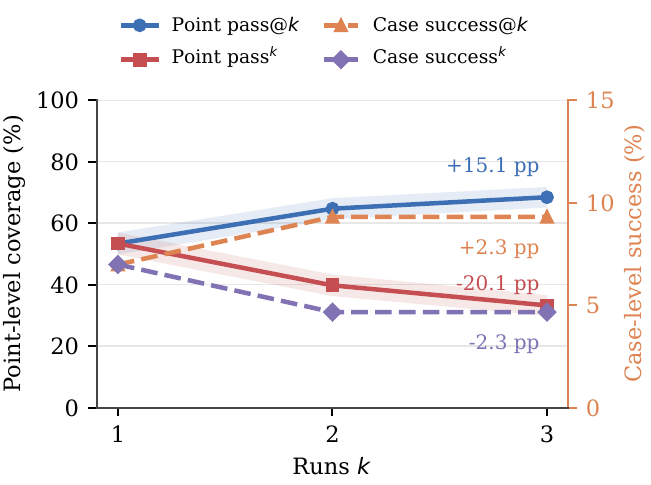
| Case-level measure | Execution | Fixed-patch judging |
|---|---|---|
| Standard deviation | 8.77 | 2.36 |
| Range | 16.34 | 4.46 |
Three runs each. Scores are measured per case before averaging, so opposing changes do not cancel out.
The table compares each case across three executions and three judgments of the same Run 1 patches. Execution varies 3.72× more by standard deviation and 3.67× more by range. The figure separately shows why any-run and every-run success differ.
| Input | Mean ± SE | Δ |
|---|---|---|
| No knowledge | 58.54 ± 5.11 | — |
| Locators only | 57.80 ± 4.84 | −0.74 |
| Repository-matched | 59.23 ± 4.77 | +0.69 |
| Shared long context | 57.03 ± 5.22 | −1.51 |
Paired comparison on the 28 cases common to all four inputs; the control is specific to this comparison.
Static knowledge changes mean score by −1.51 to +0.69 points in the paired comparison. How context enters implementation matters more than its mere availability.
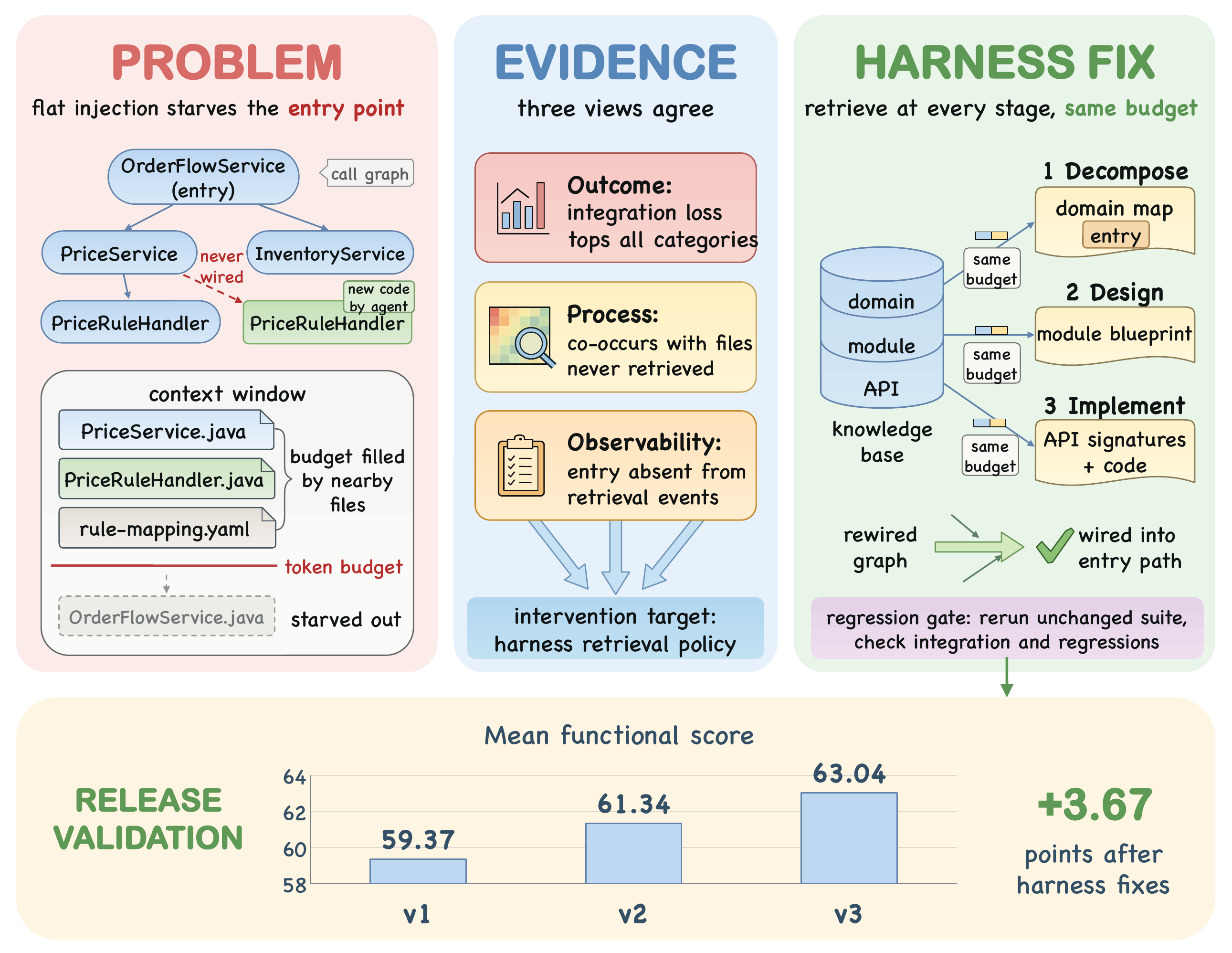
Trace-linked evidence identifies a missed entry path. Across three platform harness releases, mean score rises from 59.37 to 63.04 on the fixed suite, a 3.67-point gain from combined changes.
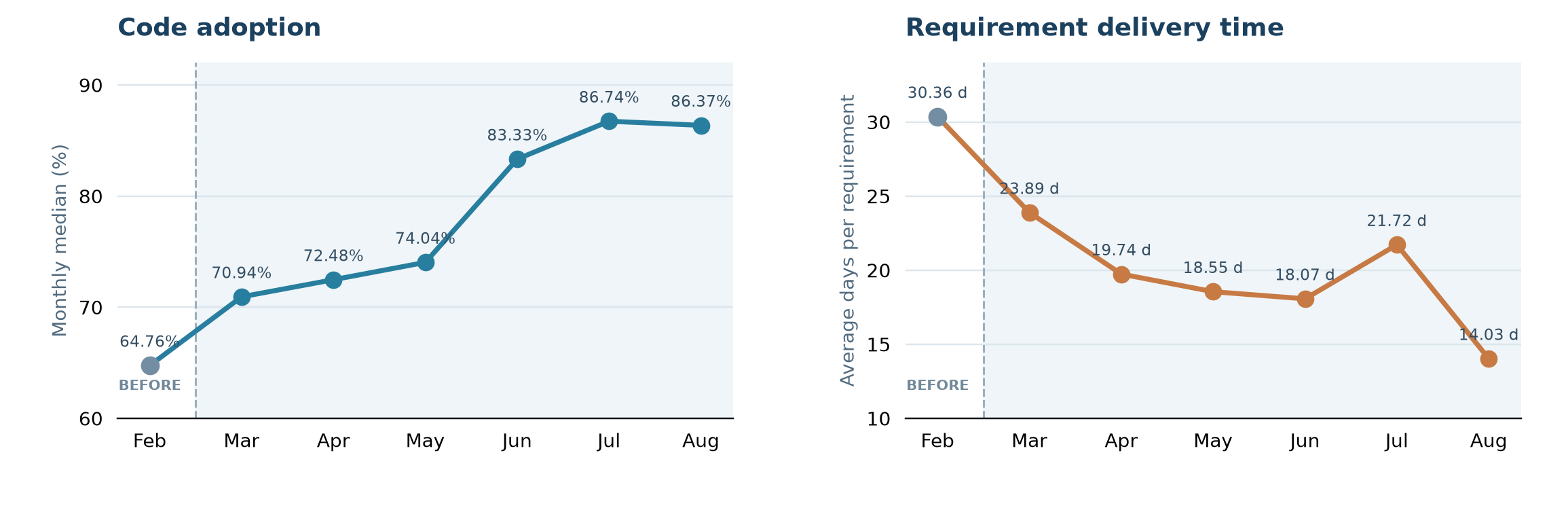
February is the predeployment reference month. From February to August, monthly median code adoption moves from 64.76% to 86.37%, while average delivery time moves from 30.36 to 14.03 days.
06 / A real task, explained
A benefit-service migration from the released real case: follow one requirement from the original conversation to a checkable delivery contract.
A customer visits a page to claim or use a benefit. Behind that page, several services supply results. The developer must replace the old benefit service across campaign, landing, promotion, and discovery pages while keeping other sources and existing page behavior working.
“Move that logic to renderNew. … Read the code and background, then clarify the requirements first.”
“A strategy can query multiple sources and therefore has multiple conversion paths. If you return early to convert one result, will the other source results be ignored?”
“Only the migration targets should be replaced; renderModuleVO must always be retained.”
Output → Standardized PRD. The migration document and user clarifications establish the final scope: use the new service, isolate its results, and preserve independent source contributions.
The PRD requires selective replacement: remove migrated legacy results, retain independent results.
The reference diff supplies the change context. Reconciliation links required behavior to the query and conversion boundaries.
When unified data is present, suppress only migrated legacy additions; preserve unrelated additions without a global early return.
source: explicitweight: 1.2753 semantic criteriaOutput → 17 reviewed Code Points. CP-14 is one of them. CP-12 separately requires a dedicated result field; CP-17 preserves discovery filtering, deduplication, and ordering.
Output → Cited point verdicts and a weighted score. For CP-14, the evaluator checks that new results take priority, independent results can still be appended, and no global early return discards them. The coding agent receives the PRD and repository; Code Points remain evaluator inputs.
This would violate CP-14 even if the new query succeeds.
Locate where independent results stop reaching the response.
Execution records help distinguish an overlooked connection from an incomplete implementation.
Output → A traceable diagnosis. The requirement, implementation evidence, and agent behavior point to a concrete place to investigate. This is a review scenario, not a claimed failure or score for this task.
An anonymized real task: migration document + initial request + later clarifications. Business labels are public aliases. The released example includes the conversation, final PRD, all 17 contracts, and a runnable rewritten code context—not original business code.
@misc{liu2026pacebench,
  title = {When Coding Agents Outpace Review: Evaluating PRD-Driven Development in Mature Enterprise Repositories},
  author = {Tianqi Liu and Yandong Guan and Songze Li and Wenkai Wang and Gang Yu and Chengfei Lv},
  year = {2026},
  eprint = {2610.26394},
  archivePrefix = {arXiv},
  primaryClass = {cs.SE},
  url = {https://arxiv.org/abs/2610.26394}
}