
CHORD
Customizing Hybrid-precision On-device Model for Sequential Recommendation with Device-cloud Collaboration
ACM Multimedia 2025 · Paper (PDF) · ACM Digital Library
CHORD gives each user a personalized recommendation model that runs on their device without training or fine-tuning a separate model for every user. It treats personalization as a quantization problem: devices share the same frozen weights, while each user gets a compact, customized mixed-precision strategy.
The challenge: customization and compression together
On-device recommendation can reduce latency, protect user data, and ease server load. Making the model personal is harder: fine-tuning on each device requires backpropagation, while sending a fresh model to every user consumes bandwidth. Three sources of variation make the problem more demanding:
- Different interests and devices. Users have different tastes, and their devices have different memory, compute, and bandwidth budgets.
- Changing interests. A user’s behavior can drift, making a one-time deployment stale.
- Frequent model updates. Transmitting updated weights to many devices is expensive.
CHORD addresses the coupled need to customize a model for each user and compress it for the user’s device, while keeping device-cloud communication small.
The idea: a per-user quantization strategy
The shared backbone stays frozen. Personalization lives in a per-user, per-channel bit-width assignment: sensitive channels keep higher precision and less sensitive channels use fewer bits. The cloud finds this quantization “lottery ticket”; the device applies it without training.
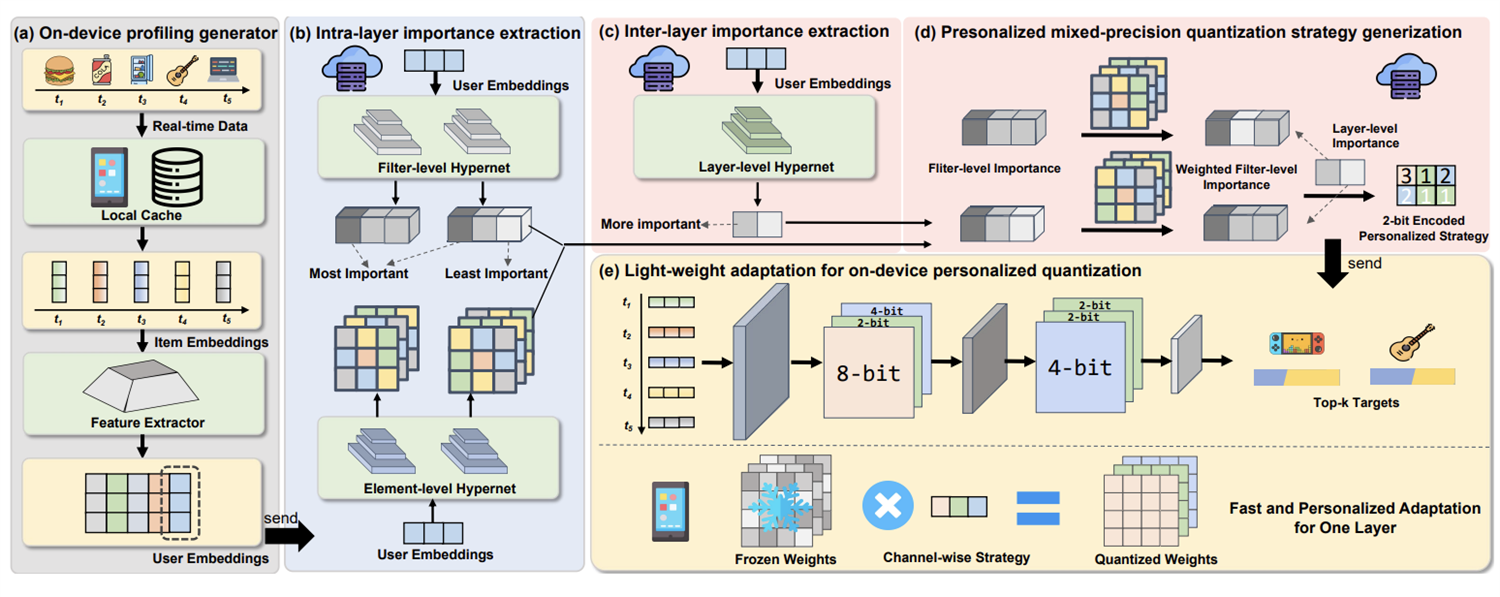
The strategy is generated in three stages:
- User profiling. Recent interactions on the device produce latent interest embeddings that capture the user’s current preferences.
- Multi-granularity sensitivity estimation. Cloud-side hypernetworks estimate element-, filter-, and layer-level parameter importance. Element-level signals reconstruct filter importance, which is then weighted by layer-level importance.
- Personalized strategy generation. The combined importance determines each channel’s precision. Only the encoded strategy is transmitted; the device decodes and applies it according to its resource budget.
Why it is efficient
- Personalized recommendation: each user receives a different precision pattern over the shared model.
- Fast adaptation: the device applies the strategy in a single forward pass, without on-device backpropagation.
- Efficient inference: importance-aware mixed precision yields a model with roughly 3-bit average precision.
- Lightweight transmission: the strategy takes 2 bits per channel, instead of sending full 32-bit weights.
Experiments
CHORD is evaluated on three real-world datasets—Amazon-CD, Yelp, and MovieLens-100K—with two sequential-recommendation backbones, SASRec and Caser. The paper reports NDCG@5/10 and HR@5/10 against full-precision and compressed baselines. It finds higher recommendation quality, faster adaptation and inference, and lower transmission overhead.
Further experiments examine tighter resource budgets, different average bit-widths, weight–activation quantization, and training stability. Visualizations show that parameter importance varies across both layers and channels, motivating a strategy tailored to each user.
Takeaway
CHORD personalizes the precision assigned to channels instead of repeatedly training or distributing personalized weights. Shared frozen weights, a compact channel-wise strategy, and one forward pass let a recommendation model adapt to users and resource-constrained devices with a small device-cloud exchange.